Seeking Research Associate for 2026-27
NSF-EPSRC project on free-surface breathers in Euler equations
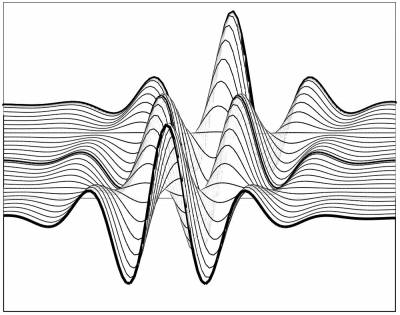
Together with Demetrios Papageorgiou (Imperial College London), Paul Milewski (Penn State), and Triantaphyllos Akylas (MIT), we are excited to announce recruitment for a 24-month Research Associate to join an internationally-leading team of mathematicians and fluid dynamicists to study the phenomena of free-surface breathers in the Euler equations.
The full team will consist of four international Lead and Co-Lead Investigators from the UK and US, two UK-based research associates (at Bath and London), and US-based graduate students.
For this particular position, the appointed Research Associate (RAs) will be based at the University of Bath, and working with Phil Trinh on the development of asymptotic and numerical theory for capturing breathers.
Brief Details
- The position is expected to start in late 2026 and held for 24 months.
- The applicant should have a PhD or nearing completion of a PhD by the start date of the grant.
- The applicant should have significant experience in the following:
- Asymptotic analysis and analytical methods applied to linear and nonlinear differential equations
- Application and development of numerical methods for solving problems in fluid phenomena, including finite-difference, boundary integral, and/or spectral methods.
- Applied and theoretical fluid mechanics
Background
In 1844, J. Scott Russell's discovery of the solitary wave in the Union Canal ushered-in a new era of nonlinear waves. At the time, the understanding had been that waves disperse quickly in water; thus Russell's report demonstrated the remarkable fact that not only are coherent wave structures possible, but they are commonly observable. Indeed, solitary waves exhibit a crucial balance between dispersive and nonlinear effects, allowing waves to retain their locally confined shape as they evolve. Since then, solitary waves have become key to the advancement of nonlinear science: their study has led to scientific breakthroughs in hydrodynamics, oceanography, geophysics, optics, mathematical biology, and theoretical physics. Crucially, the utility of the solitary wave as a paradigm problem in nonlinear mechanics is due, in part, to the possibility of reducing the full governing equations (e.g. the Euler equations in water waves) to simpler mathematical models for analysis—reductions that include the Korteweg-de Vries (KdV) equation, nonlinear Schrödinger equation (NLS), and so forth.
In the context of this proposal, breathers are generalisations of solitary waves that travel, decay in the far field, and exhibit temporal periodicity, oscillating (``breathing“) in amplitude and horizontal extent. While classic solitary waves propagate without change of shape, breathers have a more dynamic structure, with energy periodically concentrated and dispersed. Breathers have received much less attention than solitary waves, and crucially, they have not been studied in the the context of the full water-wave equations.
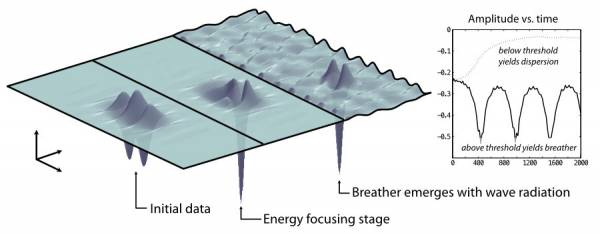
In prior work, breathers have been found only in model equations, such as the NLS, Sine-Gordon and others, and possible connections of these breathers to the phenomena of rogue waves in the ocean have been proposed. In addition, many such studies focus on breather-type solutions that tend to a finite state in the far field; hence such disturbances would not arise from locally confined (finite-energy) initial conditions. In contrast to this prior work, the focus of the proposed programme is on the study of finite-energy breathers in the context of the full free-surface Euler equations—this is an area where there has been little appreciable investigation.
The central idea is that water-wave breathers do exist and, in certain situations, they play a more important part than solitary waves in the dynamics of locally confined wave disturbances. Thus, the study of these breathers forms a new paradigm problem in nonlinear wave motion.
For more details, please see the Vision and Approach document.
Contact and how to apply
- If you are interested in the position and believe yourself to be a good match, please reach out to Phil Trinh to discuss.
- The official University of Bath advertisement and application procedures can be found here (to be filled).