This is an old revision of the document!
Table of Contents
A Summer of Mathematical Hydrology (2026)
This summer, we have a few students joining us on summer research projects. I will update this page with any relevant information.
Software
- For now, our current chat app to stay organised will be Microsoft Teams. We may change this dependent on how difficult/easy the experience is. You should be getting an invitation to join the group.
- Please get a copy of Zotero, which will help you stay organised in your reading. There is a Mathematical Hydrology Group where I will link papers and books and other things. Please see if you can access this and also send me your Zotero email and I will be able to add you as a member.
- Please see if you can obtain a copy of Matlab. This is available to Bath students. If you are external and don't have access please get in touch.
- We may get a copy of Python installed on your computer, but let us see.
Initial background reading
It can be quite difficult to get a great introduction to rainfall-runoff modelling that's both short and also mathematical. To help your initial foray into this area, I want to highlight only three references. You will be able to find these in the Zotero group library under `Summer2026-Introductory`.
Mathias book
Simon Mathias' Chapter 20 of his new book: Mathias, S. A. (2024). Rainfall runoff modelling. In Hydraulics, hydrology and environmental engineering (pp. 447–478). Springer.
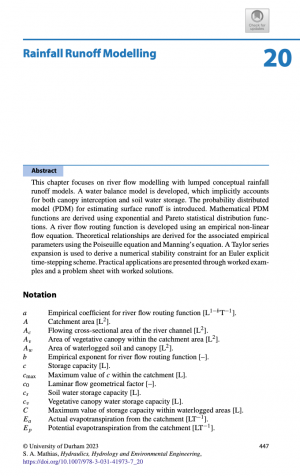
Chapter 20 covers an introduction to the basic model (though focussing on a special model known as the Probability Distributed Model). It is pitched at the audience of an undergraduate Engineering course (actually this is delivered as a fourth-year or MSc-level year), but it is generally not too sophisticated and can be understood with some help. I like how there is a little Matlab script to try.